Porous (Open Pore) Ceramic Balls
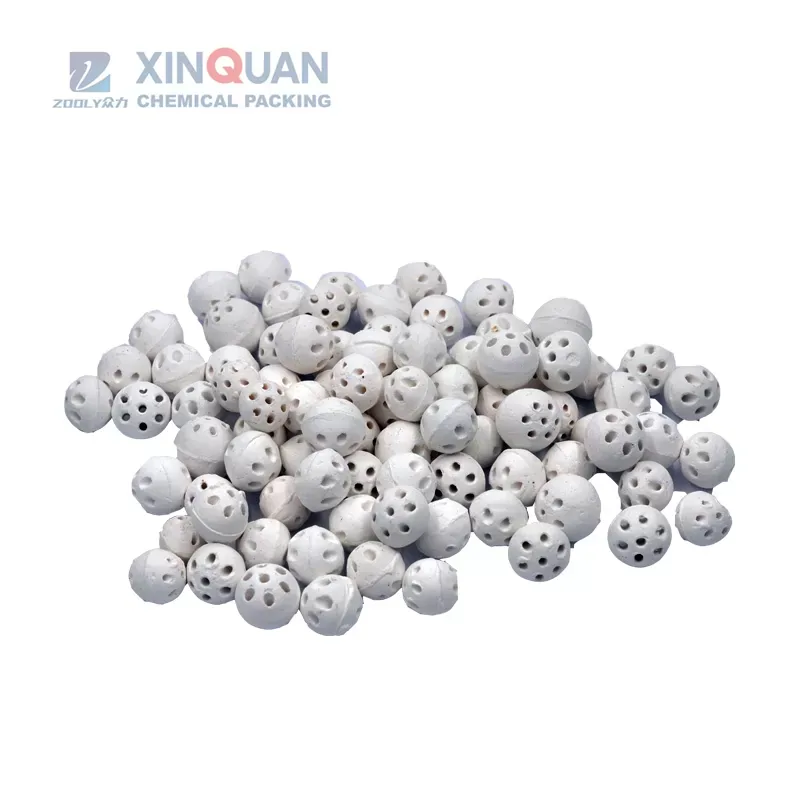
A dense inert ball is designed to do nothing. A porous ceramic ball is designed to do something: its open structure gives it surface area and permeability, which makes it useful for capturing dust and mist, for spreading two-phase flow, and as the carrier body on which catalysts are deposited. The same porosity that makes it useful also makes it weaker, so it belongs where the load is moderate.
Specifications
| Parameter | Detail |
|---|
| Form | Spheres with open (interconnected) porosity |
| Distinction | Permeable body with surface area, unlike low-porosity inert balls |
| Functions | Gas filtration and demisting, flow distribution, catalyst carrier base, packed bed support where load is light |
| Key selection inputs | Contaminant loading, allowable pressure drop, bed load, whether the ball is to be impregnated |
| Note on strength | Lower crush strength than dense grades — do not use as the bottom layer of a deep bed |
Available Materials
Porous alumina ceramic · Alumina-silicate ceramic
Typical Applications
- Dust and mist capture in gas streams
- Top layer of catalyst beds where filtration matters more than load
- Catalyst carrier base for impregnation
- Distributing two-phase flow over a section
- Pre-filters ahead of high-efficiency media
How the Options Compare
Choose a porous ball when the duty is filtration, distribution or catalyst support; choose a dense inert or high alumina ball when the duty is carrying load. Using a porous grade at the bottom of a deep bed is the classic mistake — it crushes, and the fines it releases blind the bed it was meant to protect.
Frequently Asked Questions
Porous or dense — how do I decide?
Ask what the layer is for. If it carries weight, dense. If it filters, spreads flow, or acts as a carrier, porous. If both are needed, use a dense graded layer at the bottom and a porous layer above it.
Can the balls be supplied pre-impregnated?
The carrier body can be supplied for your own impregnation route. Tell us what is being deposited and the service conditions, and we will discuss the suitable body rather than assume.
Will a porous layer increase pressure drop?
It can, and that has to be checked against the process allowance — a permeable body is more restrictive than an open grid. We size the layer depth against your allowable pressure drop.
More Ceramic Balls
Inert alumina ceramic balls for catalyst bed support, hold-down and flow distribution in reactors, columns and…
High alumina balls for heavy catalyst beds, high temperature reactors and refractory duty. Higher crush streng…
Wear resistant alumina grinding balls for ball mills and attritors. High density and low wear loss for mineral…
Ask about porous ceramic ball
Tell us your flow rate, medium and operating conditions — we recommend the right packing and internals, and quote factory-direct.
Request a Quote WhatsApp